

Call management for UK tradespeople is the practice of routing, forwarding, and responding to client calls while actively working on a job, using a combination of VoIP systems, automated SMS replies, and structured call handling rules to prevent missed opportunities. The core challenge is straightforward: you cannot answer a phone when your hands are in a wall cavity or on a roof. How UK tradespeople manage calls on site has evolved significantly, with tools like Talkroute, Digital Tradies, and AI-powered answering services replacing the old habit of letting calls go to voicemail and hoping clients wait. They rarely do.
What call forwarding and routing options do UK tradespeople use on site?
Call forwarding is the foundation of on-site phone management for tradespeople. The industry term is "conditional call forwarding," which means calls redirect automatically based on specific triggers: no answer after a set number of rings, a busy line, or the phone being switched off. UK tradespeople commonly use conditional forwarding rules that redirect calls after 3 to 4 rings to a colleague, a mobile device, or an answering service. This keeps a live person at the end of the line rather than a voicemail box.
There are three forwarding types worth knowing:
- Unconditional forwarding: Every call redirects immediately, regardless of whether you are available. Useful during full-day jobs where interruptions are not possible.
- No-answer forwarding: Calls redirect only if unanswered within a set timeout. This is the most common setup for sole traders who can sometimes pick up.
- Busy forwarding: Calls redirect when you are already on another call. Prevents clients from hearing an engaged tone and hanging up.
Beyond basic forwarding, cloud VoIP systems from providers like Talkroute offer "find-me-follow-me" routing and ring groups. A ring group means an incoming call rings multiple numbers simultaneously, so whoever is available picks up first. For a small plumbing or electrical firm with two or three operatives on different sites, this is particularly effective. Centralising inbound calls to a single business number with smart routing allows triage by query type, so an emergency leak call routes differently to a routine estimate request.
Pro Tip: Set your no-answer forwarding timeout to 20 seconds rather than the default 30. This gives you enough time to see the caller ID and decide, but routes the call before the client loses patience and rings a competitor.

How do automated missed-call text-back services support tradespeople's communication?
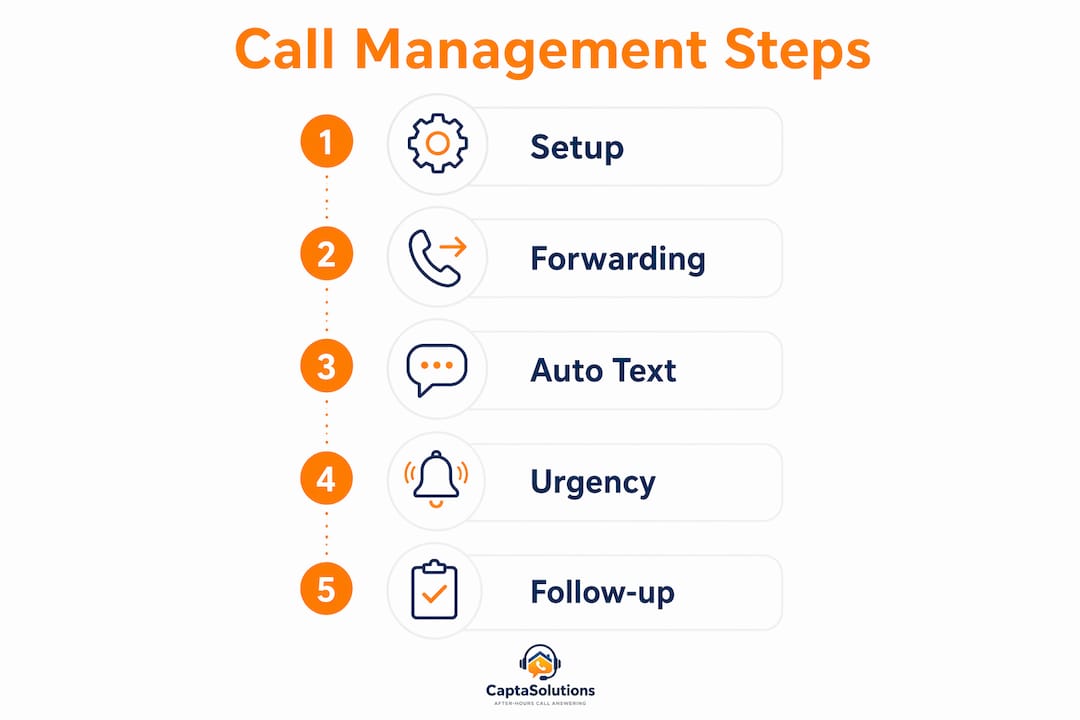
Automated missed-call text-back is a service that sends an SMS to any caller you miss, within seconds of the call disconnecting, acknowledging their call and promising a response. Missed-call text-back services are widely adopted across UK trades, with typical monthly costs ranging from £15 to £30. That cost is negligible compared to a single lost job. The message goes out automatically, so the client knows immediately that their enquiry has been received.
A typical auto-reply reads something like: "Hi, thanks for calling [Your Business Name]. We're on a job right now but will call you back within the hour. If it's urgent, reply to this message." This does three things at once. It reassures the client, sets a clear expectation, and opens a text channel for urgent follow-up. Voicemail achieves none of these reliably. Many clients simply do not leave voicemail messages, particularly younger homeowners who are accustomed to instant digital responses.
These tools also integrate with common trade CRM and job management apps, reducing manual follow-up burden. Platforms like Jobber and Tradify either include auto-text as standard or offer it as an upgrade, meaning the missed call automatically creates a lead record in your system. This is where text-back moves from a courtesy feature to a genuine business tool. You end the day with a list of qualified leads rather than a vague memory of calls you meant to return.
The advantage over voicemail is measurable in behaviour. Clients who receive an instant text reply are significantly more likely to wait for your callback than those who reach a voicemail box. Home service automation research confirms that automated text responses help providers reassure customers and maintain communication after missed calls, reducing the rate at which prospects contact a second tradesperson.
How can tradespeople organise call handling by enquiry type and urgency?
Organising calls by enquiry type is the step most tradespeople skip, and it is the one that makes the biggest difference to both client experience and your own workload. The method is to use a single business number with routing rules that direct calls based on the nature of the enquiry or the time of day. Construction communications require a unified mobile presence that adapts dynamically to site team availability, which means your call handling setup should mirror your actual working day.
A practical framework for organising calls looks like this:
- Emergency calls: Route immediately to your mobile or a designated emergency contact. Use a short ring timeout and a fallback to a live answering service if unanswered.
- New enquiries and estimates: Route to a voicemail or auto-text system during working hours, with a scheduled callback window in the early evening or between jobs.
- Existing client queries: Route to a job management app inbox or SMS, allowing clients to send photos or details without requiring a live call.
- After-hours calls: Route to an AI-powered answering service or a 24-hour call handling provider that can capture details and qualify the enquiry.
This structure prevents the common problem of urgent calls being buried alongside routine ones. A boiler engineer who receives an emergency call at 9am while fitting a bathroom should not miss it because the phone was on silent to avoid interruptions from estimate requests. Separating the two call types by routing rule solves this without requiring you to answer every call manually. Mobile apps from VoIP providers allow you to adjust these rules in real time from your phone, so if you move from a routine job to an emergency callout, you can update your routing in under a minute.
What practical tips and tools improve call management efficiency on UK job sites?
The most overlooked technical detail in tradespeople phone management is the alignment between forwarding timeouts and voicemail delays. Forwarding timeouts must be aligned with destination voicemail settings to prevent forwarded calls being directed to the wrong voicemail system. If your VoIP system forwards after 20 seconds but your mobile voicemail picks up after 15 seconds, the client ends up in your personal voicemail rather than your business one. This is a common and easily fixed error.
Practical tools worth using include:
- VoIP mobile apps: Apps from providers like Talkroute or 3CX let you manage call routing, listen to messages, and handle calls from your smartphone using your business number. No desk phone required.
- Scheduled callback windows: Block 30 minutes at the end of each working day for returning calls. Communicate this window in your auto-text reply so clients know when to expect you.
- AI receptionists and answering services: Automated call answering services can handle FAQs, bookings, and after-hours calls, with tiered pricing ranging from £49 to over £100 per month depending on call volume and service level.
Pro Tip: When using an AI-powered answering service, check that it complies with UK regulations. AI voice agents must disclose their automated nature within the first 5 seconds of a call under GDPR and PECR rules. Any service that does not do this exposes your business to regulatory risk.
For sole traders, the most cost-effective starting point is a missed-call text-back service combined with a no-answer forwarding rule to a live answering service during peak hours. This combination covers the majority of call scenarios without requiring you to be available at all times. Voicemail should be a last resort, not the default. Conditional call forwarding to a live person or automated service increases the likelihood of a positive caller experience and reduces the number of enquiries lost to competitors.
Key takeaways
Effective on-site call management for UK tradespeople requires conditional forwarding, automated text-back, and enquiry-type routing working together as a system, not as isolated tools.
| Point | Details |
|---|---|
| Conditional call forwarding | Set forwarding after 3 to 4 rings to a colleague or answering service, not voicemail. |
| Automated text-back | Send an instant SMS to every missed caller; costs £15 to £30 per month and prevents lost leads. |
| Enquiry-type routing | Separate emergency, new enquiry, and after-hours calls using routing rules on a single business number. |
| Timeout alignment | Match VoIP forwarding timeouts to destination voicemail delays to avoid calls landing in the wrong inbox. |
| AI compliance | Any AI answering service must disclose its automated nature within 5 seconds under UK GDPR and PECR rules. |
Why most tradespeople are one missed call away from losing a job
I have spoken with enough trades business owners to know that the majority treat call management as an afterthought. They set up a voicemail greeting when they first get a business phone and never revisit it. The result is a system that was designed for convenience in 1998 and has not changed since.
The uncomfortable truth is that a client who reaches voicemail on a first call will, in most cases, ring the next tradesperson on their list before you have even seen the notification. This is not a criticism of clients. It is simply how people behave when they have a problem and a list of options. The tradesperson who answers, or who sends an immediate text reply, wins the job. The one who calls back two hours later often finds the work has already been allocated.
What I find most interesting is that the tools to fix this are neither expensive nor complicated. A missed-call text-back service at £20 per month and a no-answer forwarding rule set up in ten minutes on a VoIP app will cover the vast majority of scenarios. The barrier is not cost or complexity. It is the assumption that "clients will leave a message if it's important." Many will not. Structuring your call answering approach around that reality, rather than hoping clients adapt to your availability, is what separates trades businesses that grow from those that plateau.
The tradespeople who handle this best treat their phone system as part of their business infrastructure, the same way they treat their van or their tools. They invest a small amount of time and money in setting it up properly, and then it runs without them having to think about it. That is the standard worth aiming for.
— Daniel
How Captasolutions helps UK tradespeople never miss a call
Every missed call is a missed job. Captasolutions is an AI-powered call answering service built specifically for UK businesses that cannot afford to lose an enquiry while on site.
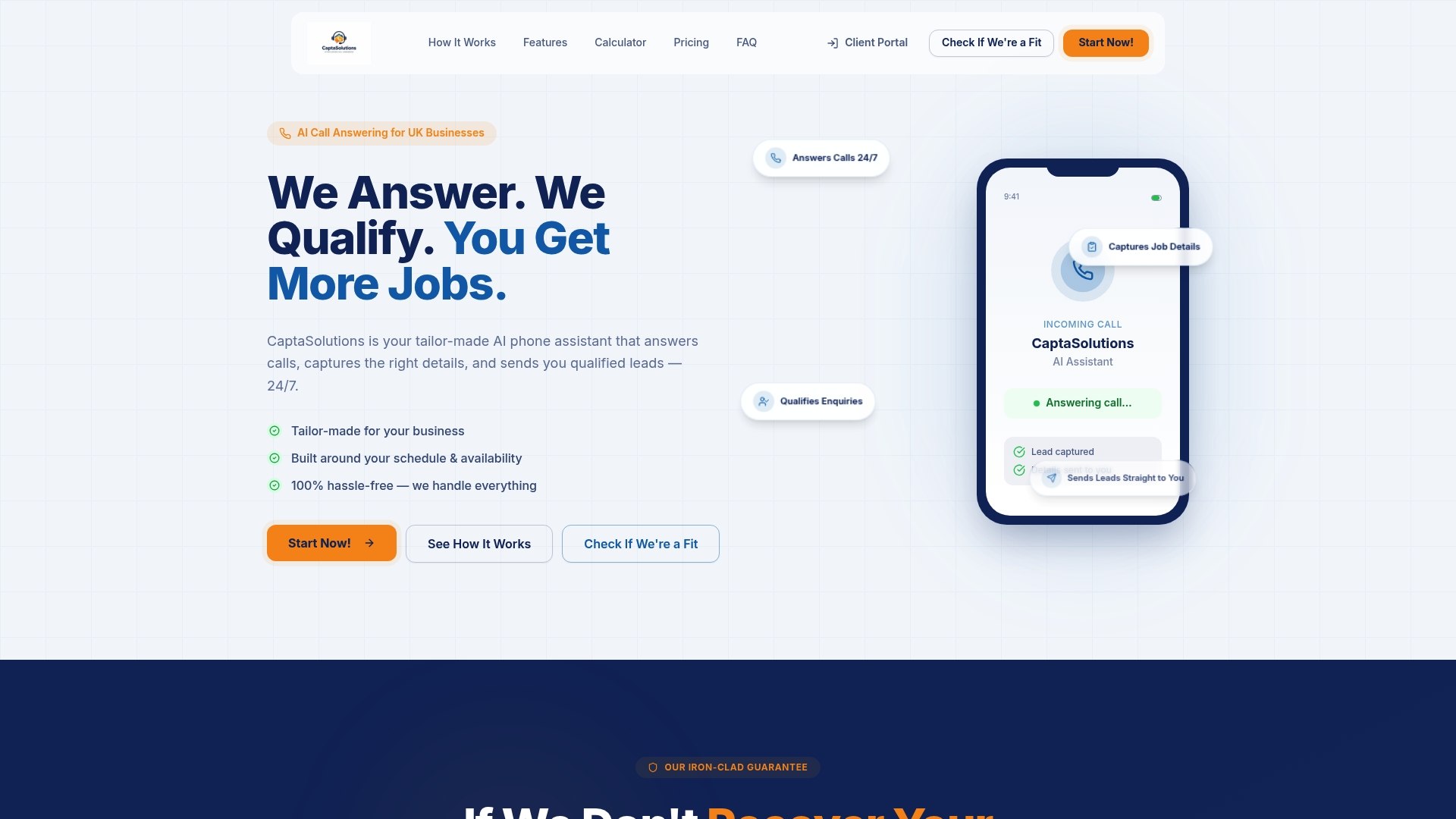
Captasolutions answers every call in your business name, 24 hours a day, 7 days a week. The AI captures caller details, qualifies the enquiry, and organises everything into your client portal so you can review leads and decide what to take on. There is no contract, no card required, and you can be live within the hour. For tradespeople who want a structured approach to covering business calls without hiring staff, Captasolutions is the direct solution. Start your free 30-day trial at captasolutions.co.uk or call 07346 811329.
FAQ
What is the best way to handle calls while working on site?
Set up conditional call forwarding to redirect unanswered calls to a colleague, live answering service, or AI receptionist after 3 to 4 rings. Pair this with an automated missed-call text-back service to reassure any callers who do not connect.
How much does a missed-call text-back service cost in the UK?
Typical monthly costs range from £15 to £30 for a missed-call text-back service, making it one of the most cost-effective tools available for tradespeople phone management.
Do AI call answering services comply with UK regulations?
Yes, provided they are set up correctly. Under GDPR and PECR, AI voice agents must disclose their automated nature within the first 5 seconds of a call and cannot impersonate named individuals without consent.
Can I use a single number for all my business calls on site?
Yes. VoIP systems allow you to route a single business number to multiple devices or contacts based on time of day, enquiry type, or availability, which is the standard approach for managing calls on construction sites.
What happens if my forwarding setup sends calls to the wrong voicemail?
This occurs when your VoIP forwarding timeout is longer than the voicemail pickup delay on the destination phone. Align both settings so the forwarded call reaches a live person or your business voicemail, not a personal inbox.