

AI systems name your business by synthesising signals from your online presence, not by consulting a master list. When a potential customer asks ChatGPT or Perplexity "who's the best plumber near me," the AI cross-references your Google Business Profile, your website content, your reviews, and your mentions across directories and press. If those signals are consistent, clear, and authoritative, your business name appears in the answer. If they conflict or are thin, a competitor's does.
The core principle is entity recognition. AI engines treat your business as a distinct entity, and they need enough corroborating evidence to name it with confidence. Pages that answer questions clearly and immediately get cited up to four times more often by AI than pages that open with context or brand storytelling. That single finding should reshape how you write every page on your site.
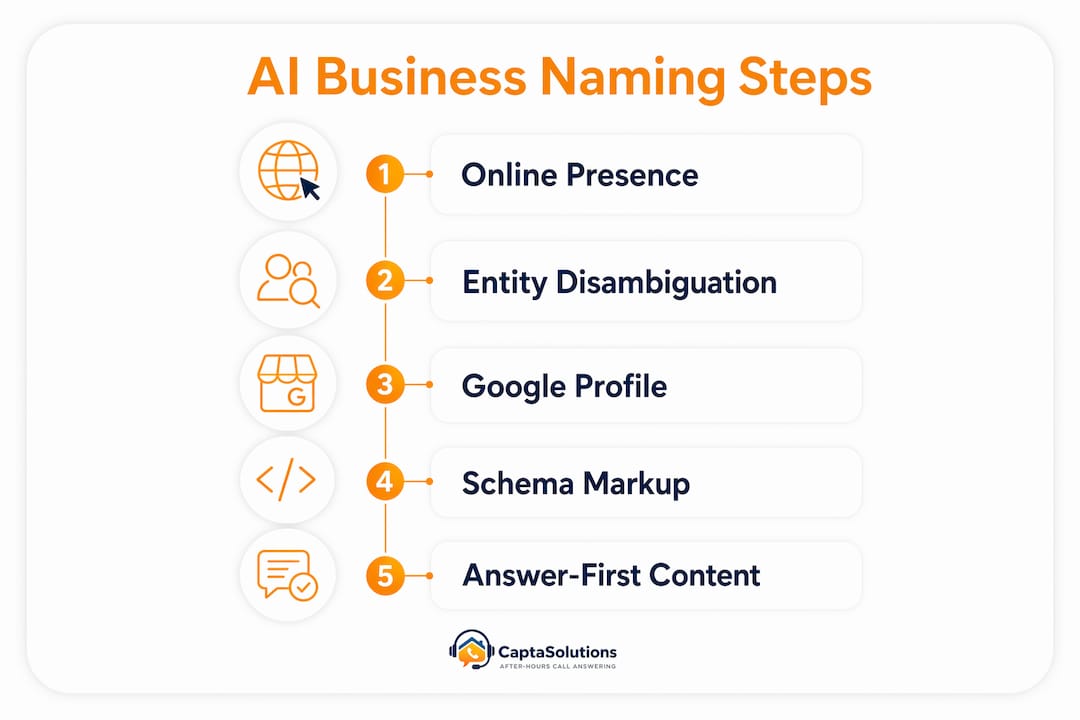
The foundational elements AI uses to name your business:
- A complete, verified Google Business Profile with accurate categories, services, and recent reviews
- Consistent Name, Address, and Phone (NAP) data across every listing and directory
- Answer-first website content with real numbers and direct responses to customer questions
- Schema.org LocalBusiness and FAQPage markup on key pages
- Authoritative third-party mentions on directories, trade press, and industry sites
- A steady stream of recent, specific customer reviews
How AI builds its understanding of your business name
AI engines do not maintain a single master business list. They synthesise entity understanding from fragmented, dispersed online data, relying heavily on consistent NAP and authoritative citations. Think of it as a confidence score: the more sources that agree on who you are and what you do, the more confidently the AI names you.

Entity disambiguation is the process at the heart of this. When an AI encounters "Apex Digital," it may resolve that string to dozens of different companies. Brands with categorically clear names gain AI mentions faster because the AI can assign them to a single, unambiguous entity without guesswork. A name like "Sheffield Boiler Repairs" carries an immediate categorical signal. A name like "Nexus Solutions" does not.
Trust compounds over time. The AI's confidence in your entity grows as more authoritative sources corroborate the same facts about your business. A Companies House listing, a trade association directory entry, a local press mention, and a well-maintained Google Business Profile all feed into that confidence. No ad product or monthly fee guarantees AI answer placement; visibility depends entirely on authoritative, clear content.
Pro Tip: Run your business name as a standalone query in ChatGPT, Perplexity, and Google. Note what entity the AI resolves it to. If it returns a competitor or nothing at all, you have a disambiguation problem to fix before anything else.
Why your Google Business Profile is your most powerful AI signal
Google Business Profile is the single biggest source AI engines use for local recommendations. Complete, active profiles with recent reviews greatly increase the chances of being named in an AI response. For UK businesses targeting local customers, this is the highest-leverage action available.

AI Overviews and Gemini draw directly from Google's live index, and your Business Profile sits at the centre of that. Every field you leave blank is a gap in the AI's understanding of your entity. Categories, service descriptions, opening hours, service areas, and photos all contribute to the structured data the AI extracts.
Discrepancies in NAP data reduce AI confidence and lead to competitor selection. If your phone number on Google differs from the one on Yell.com or your own website, the AI treats that as a reliability signal against you.
Practical steps to optimise your Google Business Profile for AI visibility:
- Claim and verify your profile if you have not already done so
- Select the most specific primary category available for your trade or service
- Add secondary categories for every relevant service you offer
- Write a keyword-natural business description that answers "what do you do and where"
- List every service with a short description and, where possible, a price range
- Upload recent photos of your work, premises, or team
- Post updates at least twice a month to signal an active, current business
- Respond to every review, positive or negative, within 48 hours
- Check that your NAP data matches exactly across Google, Bing Places, Apple Maps, and your main directories
For home service businesses, improving AI discoverability through a well-structured web presence works alongside your Business Profile, not instead of it.
How schema markup and FAQ content help AI understand you
Adding LocalBusiness and FAQPage schema markup helps AI engines extract and cite your business facts reliably. Structured data makes those facts machine-readable and unambiguous, which is precisely what an AI needs to cite you with confidence rather than hedging.
Schema.org LocalBusiness markup tells the AI your exact name, address, phone number, geographic coordinates, opening hours, and price range in a format it can parse without interpretation. FAQPage markup does something different: it presents your customer questions and your answers as a structured pair, making it trivially easy for an AI to lift a clean response and attribute it to your business.
Answer Engine Optimisation treats your website pages as authoritative data sources with clear, fact-backed answers matching customer queries. The discipline is sometimes called AEO, and it sits on top of standard SEO rather than replacing it.
Best practices for schema markup and FAQ content:
- Implement LocalBusiness schema on your homepage and contact page, including name, address, phone, geo coordinates, and opening hours
- Add FAQPage schema to any page that contains a question-and-answer section
- Write FAQ questions in the exact phrasing your customers use when speaking to a voice assistant or typing into ChatGPT
- Keep answers short, direct, and factual; include a real number wherever possible (a price, a timeframe, a distance)
- Avoid burying your FAQ on a standalone page nobody links to; bolt it onto your best-performing service pages instead
- Validate your markup using Google's Rich Results Test before publishing
Pro Tip: Structure FAQ headings as complete questions: "How much does a boiler service cost in Leeds?" outperforms "Boiler servicing" as a heading every time an AI matches it to a customer prompt.
Seven steps to get your business named by AI
Four areas dominate local AI recommendations: your Google Business Profile, consistent data, reviews, and authoritative third-party mentions. The seven steps below build on those foundations in a practical sequence for UK business owners.
-
Complete your Google Business Profile. Claim, verify, and fill every field. This is the single action with the fastest impact on local AI naming, particularly for Google AI Overviews and Gemini.
-
Rewrite your key pages answer-first. Open each important page with a direct, quotable answer to the question it targets. Answer-first content with a direct, numbered answer in the first two sentences consistently gains AI citations. Save the backstory for paragraph three.
-
Add schema markup. Implement LocalBusiness schema on your homepage and FAQPage schema on any page with a question-and-answer section. This makes your facts machine-readable across ChatGPT, Perplexity, Google, and Microsoft Copilot.
-
Build review velocity. Ask every satisfied customer for a review as a matter of routine, not a one-off campaign. Recency matters as much as volume. Specific reviews that mention your service, location, and outcome give the AI quotable material to use in its responses.
-
Audit and fix your NAP consistency. Check your business name, address, and phone number across Google, Bing Places, Apple Maps, Yell, Checkatrade, and any trade association directories. Every discrepancy is a confidence penalty.
-
Earn third-party mentions. Get listed and talked about beyond your own site. Local press coverage, niche trade directories, partner pages, and genuine community answers on forums all tell the AI your business exists beyond your own marketing. A multi-location AI strategy requires this at scale.
-
Monitor your AI visibility monthly. Run buyer-intent queries ("best [your service] in [your city]") across ChatGPT, Perplexity, and Google in a logged-out window. Record whether you appear, which competitor does if you do not, and which page got cited. Track AI Overview impressions in Google Search Console. Adjust based on what you find.
Perplexity runs live web searches and footnotes its sources, making quotable, retrievable pages crucial. Changes you make today can surface in Perplexity within days. ChatGPT's default mode draws more from training data, so broader web presence matters there and shifts more slowly.
How Captasolutions helps UK businesses be recognised and contacted by AI
When AI names your business and a customer picks up the phone, what happens next determines whether that lead converts. Captasolutions is an AI-powered call answering service built specifically for UK businesses that cannot afford to miss a call.
The service is particularly valuable for trades businesses, salons, clinics, hospitality venues, and professional offices where the person best placed to answer is often unavailable. An AI recommendation from Perplexity or Google can arrive at 7PM on a Tuesday. If nobody answers, that customer moves on.
Why UK service businesses trust Captasolutions:
- Calls answered in your business name, maintaining brand consistency from the first word
- Lead qualification built in, so you receive organised, actionable enquiries rather than raw voicemails
- A client portal that keeps every lead visible and easy to follow up
- No contract, no card required, and live within the hour
- Free 30-day trial so you can test it against real inbound volume
For tradespeople specifically, the call answering benefits extend beyond convenience. A missed call from an AI-referred customer is a warm lead lost to a competitor who did answer.
Start your free trial at Captasolutions today. No contract, no card, live within the hour.
Key takeaways
Getting AI to name your business consistently requires clear entity signals, answer-first content, and structured data working together across every platform where your business appears.
| Point | Details |
|---|---|
| Entity clarity drives AI naming | Categorically clear business names and consistent NAP data give AI the confidence to cite you over a competitor. |
| Google Business Profile is the top lever | Complete, active profiles with recent reviews greatly increase the chances of appearing in local AI recommendations. |
| Answer-first content gets cited four times more | Pages that answer the question in the first two sentences are cited up to four times more often than narrative-led pages. |
| Schema markup makes facts machine-readable | LocalBusiness and FAQPage schema help AI engines extract and cite your business details reliably and without ambiguity. |
| Monitor monthly and adjust | Run buyer-intent queries across ChatGPT, Perplexity, and Google each month to track whether your business is being named. |