

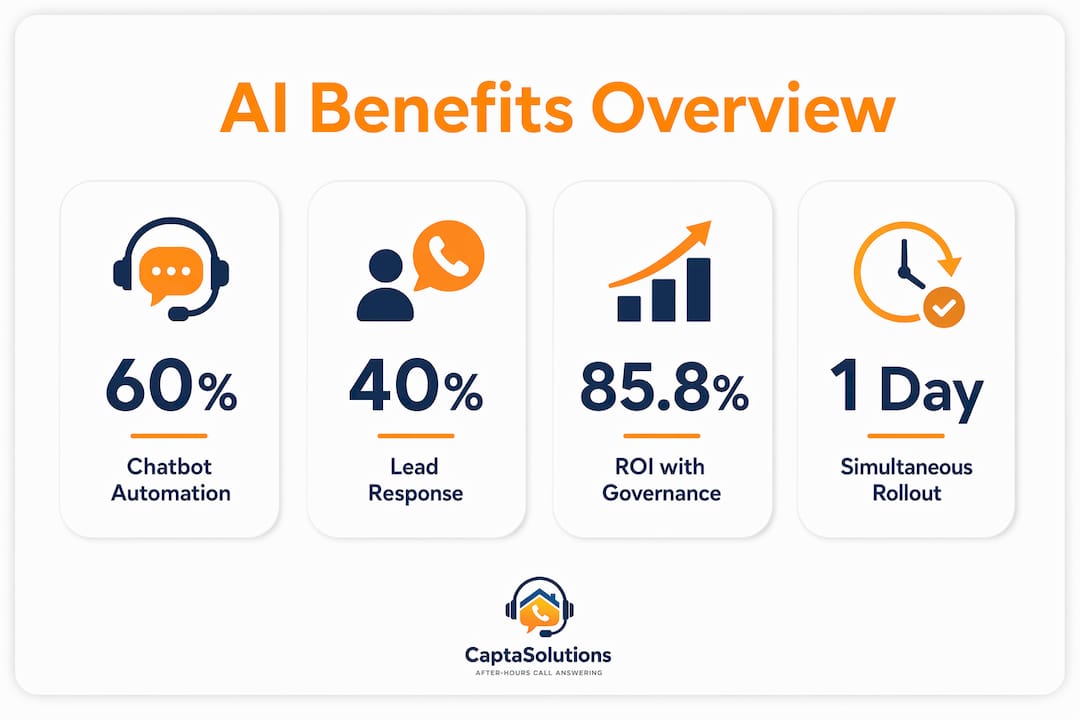
AI is the most effective tool UK business owners have for managing multiple sites without losing control of quality, consistency, or customer experience. Understanding how AI supports UK multi-location businesses means understanding one core principle: centralisation. When AI automates routine tasks and aggregates data across every location into one system, you stop firefighting and start making decisions based on real information. Organisations with mature AI governance report an 85.8% measurable ROI, compared to just 20.0% with no formal governance. That gap is not a coincidence. It is the direct result of structured deployment, and it is achievable for any UK business owner willing to commit to it.
How AI supports UK multi-location businesses: the core operational case
Running two or more sites creates a specific set of problems that single-location owners never face. Processes drift between locations. Reporting becomes fragmented. Staff at one site handle customer enquiries differently from staff at another. These inconsistencies cost you customers and margin without ever appearing on a spreadsheet.
AI addresses these problems by centralising the tasks that cause drift. Review management, lead response, appointment scheduling, and performance reporting can all be automated from a single system that applies the same rules across every site. AI agents for multi-location management deliver improved customer engagement and operational insight precisely because they remove the human variability that causes inconsistency.

The deployment strategy matters as much as the tools you choose. Rolling out location by location creates a two-speed operation where some sites benefit and others fall behind, which complicates management more than having no AI at all. The businesses that see the strongest results deploy AI across all sites simultaneously, setting the same standards from day one.
Key operational tasks AI handles across multiple sites:
- Review management: AI monitors and responds to customer reviews across Google, Trustpilot, and other platforms in a consistent brand voice.
- Lead qualification: AI captures enquiries, asks qualifying questions, and routes serious leads to the right team member at the right location.
- Appointment scheduling: AI books, confirms, and reschedules appointments without staff involvement, reducing no-shows and admin time.
- Performance reporting: AI pulls data from every site into a single dashboard, giving you a clear picture of which locations are performing and which need attention.
Pro Tip: Deploy AI tools across all your sites on the same day, using the same configuration. Staggered rollouts create inconsistency in customer experience and make it harder to measure what is actually working.
How does structured AI implementation improve ROI?
A structured approach to AI adoption triples the likelihood of positive ROI within one year. Structured AI plans also yield 5–10% productivity gains within 12–18 months. Those numbers reflect businesses that follow a deliberate roadmap rather than adopting tools reactively.
A practical roadmap for UK multi-location business owners looks like this:
- Audit your current processes. Identify the three to five tasks that consume the most staff time across your locations. These are your first AI targets.
- Run a 90-day pilot. Choose one AI tool, deploy it across all sites simultaneously, and measure the impact against a clear baseline. Finance automation, customer enquiry triage, and marketing content drafting are the most common starting points.
- Assign an AI owner. One person in your organisation needs accountability for AI adoption. They review performance data, identify problems, and drive ongoing improvement.
- Scale what works. After 90 days, you have real data. Use it to decide which tools to expand and which to replace.
- Build governance into the process. Document how AI tools are used, who has access, and how decisions are reviewed. This is what separates the 85.8% ROI group from the 20.0% group.
The State of UK AI Adoption Survey 2026 shows that only 21% of UK mid-market organisations have mature AI governance. That means the majority of your competitors are leaving ROI on the table. Getting governance right now is a genuine competitive advantage.
Pro Tip: Assign a named AI owner within your business, not an external consultant. Businesses that rely mainly on external consultants for AI capability report just 13.6% ROI, compared to 72.7% for those that build internal skills.
What practical AI tools can UK multi-location owners use in 2026?
The most useful AI tools for multi-location businesses are not the most complex ones. They are the ones that connect your existing systems and remove manual work from your team's day.
AI-powered chatbots handle 40–60% of routine customer enquiries automatically within the first month of deployment. That means your staff spend less time answering the same questions and more time on work that requires human judgement. For a business with five locations, that reduction in repetitive enquiry handling adds up quickly.
Centralised dashboards are the second most impactful tool category. Aggregation layers built on top of your existing point-of-sale, scheduling, and CRM systems allow centralised reporting and standardisation without replacing the systems your staff already know. You get a single view of all locations without a disruptive and expensive system overhaul.
Local marketing automation is the third area worth prioritising. AI can generate location-specific content for social media, email campaigns, and Google Business profiles, adapting the message for each site while staying within your brand guidelines. AI-driven local marketing needs to be managed within brand guidelines but tailored by location for effectiveness and compliance.
| AI tool category | Primary function | Measurable benefit |
|---|---|---|
| AI chatbots and voice agents | Handle routine enquiries and lead qualification | 40–60% of enquiries resolved automatically |
| Centralised dashboards | Aggregate data from all sites | Single-view reporting without system replacement |
| Local marketing automation | Generate location-specific content | Consistent brand with local relevance |
| AI call answering | Capture and qualify inbound calls 24/7 | No missed leads outside business hours |
AI voice agents deserve particular attention for multi-location service businesses. An AI voice agent answers every call in your business name, qualifies the enquiry, and logs the details to a central portal. For a trades business, a restaurant group, or a salon chain, this means no missed calls regardless of how busy any individual site is.
How do you maintain compliance and data security with AI?
AI governance is not a bureaucratic exercise. It is the mechanism that determines whether your AI investment produces returns or creates liability. Cross-departmental AI agents delivering broad organisational integration yield 84.7% ROI compared to 24.1% for narrow single-task agents. Integration requires governance, because connected systems touch more data and more processes.
The compliance basics every UK business owner needs to address:
- UK GDPR lawful basis: AI tools processing personal data require a documented lawful basis. For most customer-facing AI, this is legitimate interest or contract performance.
- Data Protection Impact Assessments: Any AI tool that processes personal data at scale or makes automated decisions about individuals may require a formal DPIA before deployment.
- Multi-factor authentication: Baseline cybersecurity for AI tool access includes multi-factor authentication and strong password policies across all user accounts.
- AI tool logs: Maintain logs of what your AI tools do, when they do it, and who reviews the outputs. This is your audit trail if a decision is ever challenged.
- Human escalation paths: AI handles first-pass tasks. Humans handle escalations, complaints, and any decision with significant consequences for the customer.
Pro Tip: Before deploying any AI tool that handles customer data, check whether the provider stores data on UK or EU servers. Data residency matters under UK GDPR, and it is a question many business owners forget to ask.
Successful UK service businesses use AI to handle routine tasks with human oversight for complex decisions, precisely because regulatory constraints require it. This is not a limitation. It is a sensible division of labour that protects your business and your customers.
Key takeaways
AI supports UK multi-location businesses most effectively when it is deployed simultaneously across all sites, governed with clear accountability, and integrated across workflows rather than applied to isolated tasks.
| Point | Details |
|---|---|
| Deploy simultaneously across all sites | Staggered rollouts create two-speed operations that undermine brand consistency and complicate management. |
| Governance drives ROI | Organisations with mature AI governance report 85.8% measurable ROI versus 20.0% with no governance. |
| Structured plans triple ROI likelihood | A 90-day pilot with clear measurement and a named AI owner significantly increases the chance of positive returns. |
| Integration beats sophistication | Cross-departmental AI agents yield 84.7% ROI compared to 24.1% for narrow single-task tools. |
| Compliance is non-negotiable | UK GDPR requires documented lawful bases and human oversight for AI tools handling customer data. |
What I have learned from watching UK multi-location businesses adopt AI
The businesses that struggle with AI adoption share one characteristic: they treat it as a technology project rather than an operational decision. They buy tools, assign them to an IT contact or an external consultant, and wait for results that never arrive. The businesses that succeed treat AI adoption the same way they treat hiring a key member of staff. They define the role, set expectations, measure performance, and hold someone accountable.
The AI and UK trades business efficiency conversation has matured considerably in 2026. Business owners are no longer asking whether AI is worth it. They are asking how to make it work across multiple sites without losing the personal touch that built their reputation. The answer is always the same: start with the tasks that cost you the most time and the most customers, deploy consistently, and keep a human in the loop for anything that matters.
The workforce dimension is the one most business owners underestimate. No organisation with poorly equipped employees for AI reports measurable ROI. Buying the right tools is the easy part. Getting your team to use them confidently, every day, across every site, is where the real work happens. Invest in that, and the returns follow.
The UK economy could gain a £1 trillion boost over a decade with deeper AI adoption integrated into workflows. That figure is a national aggregate, but it reflects what happens at the business level when AI is taken seriously. The gains are real. They just require commitment.
— Daniel
Captasolutions: AI-powered support for UK multi-location businesses
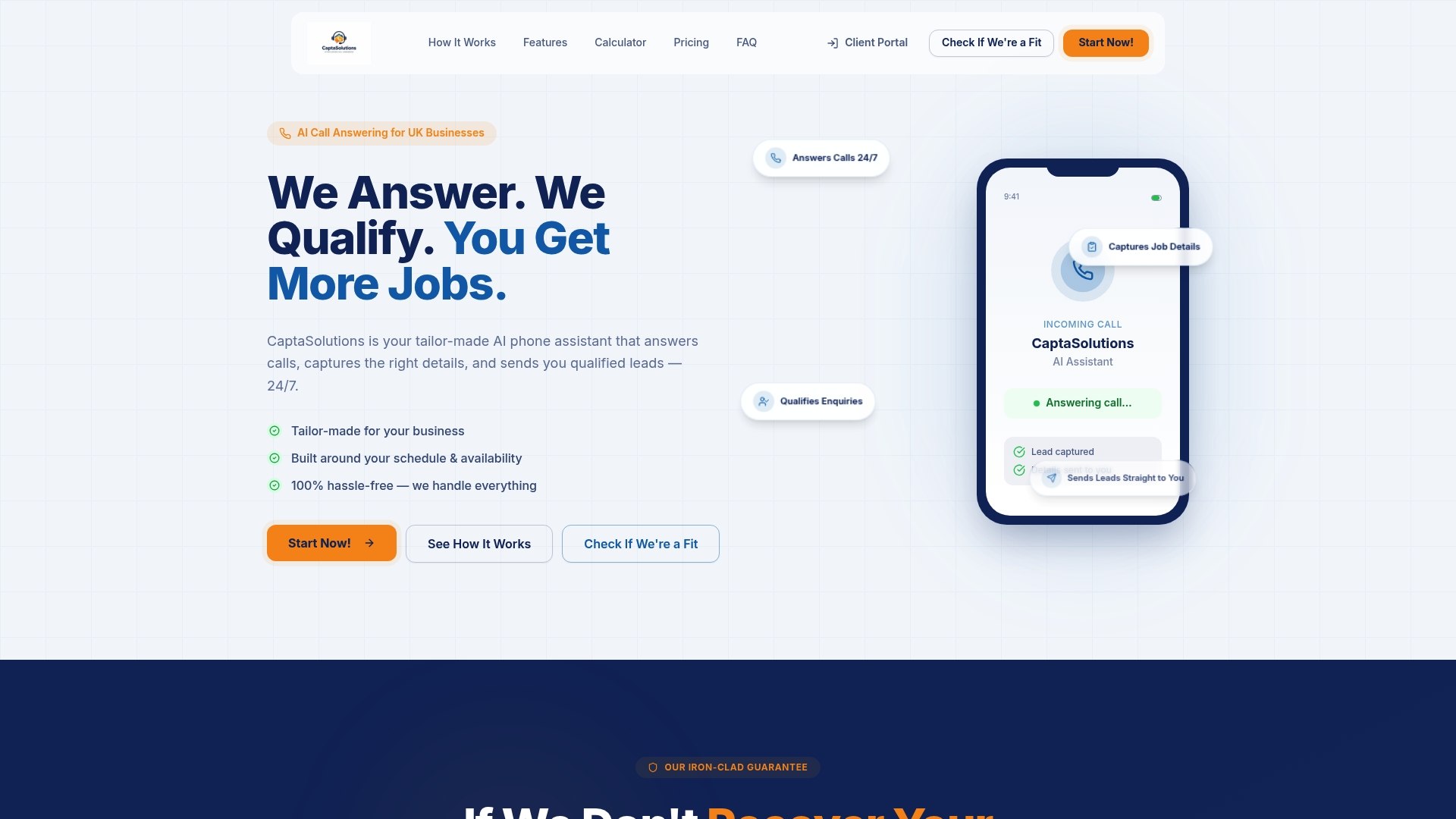
Captasolutions is built for UK businesses that cannot afford to miss a call, whether you are running one site or ten. The AI answers every call in your business name, 24 hours a day, 7 days a week, capturing caller details and qualifying each enquiry before logging everything to your central client portal. You review every lead and decide what to take on. For business owners managing multiple locations across the UK, this means consistent customer handling at every site without adding headcount. There is no contract, no card required, and you can be live within the hour. Start your free 30-day trial at captasolutions.co.uk or call 07346 811329 today.
FAQ
How does AI help UK businesses manage multiple locations?
AI centralises operations by automating routine tasks such as call answering, lead qualification, scheduling, and reporting across all sites from a single system. This removes process inconsistency and gives business owners a clear view of performance at every location.
What ROI can UK multi-location businesses expect from AI?
Organisations with mature AI governance report an 85.8% measurable ROI, and structured AI plans triple the likelihood of positive returns within one year. Businesses that integrate AI across departments rather than applying it to single tasks see the strongest results.
Do AI tools for UK businesses need to comply with UK GDPR?
Any AI tool that processes personal data requires a documented lawful basis under UK GDPR, and high-risk tools may require a Data Protection Impact Assessment. Human oversight for escalations and complaints is both a legal safeguard and a practical requirement.
What is the best way to deploy AI across multiple UK sites?
Deploy AI simultaneously across all locations using the same configuration, rather than rolling out site by site. Staggered adoption creates operational inconsistency and makes it harder to measure what is working.
How do AI voice agents support multi-location service businesses?
AI voice agents answer inbound calls in your business name, qualify the enquiry, and log the details centrally, ensuring no call is missed regardless of how busy any individual site is. For trades businesses, restaurants, and salons, this directly reduces lost leads outside business hours. Learn more about AI call answering uses across UK service businesses.