

AI is the most direct route to operational efficiency for UK trades businesses, cutting admin time, reducing booking errors, and keeping customer enquiries moving around the clock. The role of AI in UK trades business efficiency is no longer theoretical. UK SMEs using AI save 5.2 hours per week, with time saved, reduced errors, and lower operational costs cited as the top three benefits. For a sole trader or small trades firm, that is the equivalent of reclaiming half a working day every week. Tools like ChatGPT, Sage Copilot, and AI chatbots are already embedded in trades operations across the UK, handling everything from lead qualification to invoice reminders.
What are the main AI tools improving efficiency in UK trades businesses?
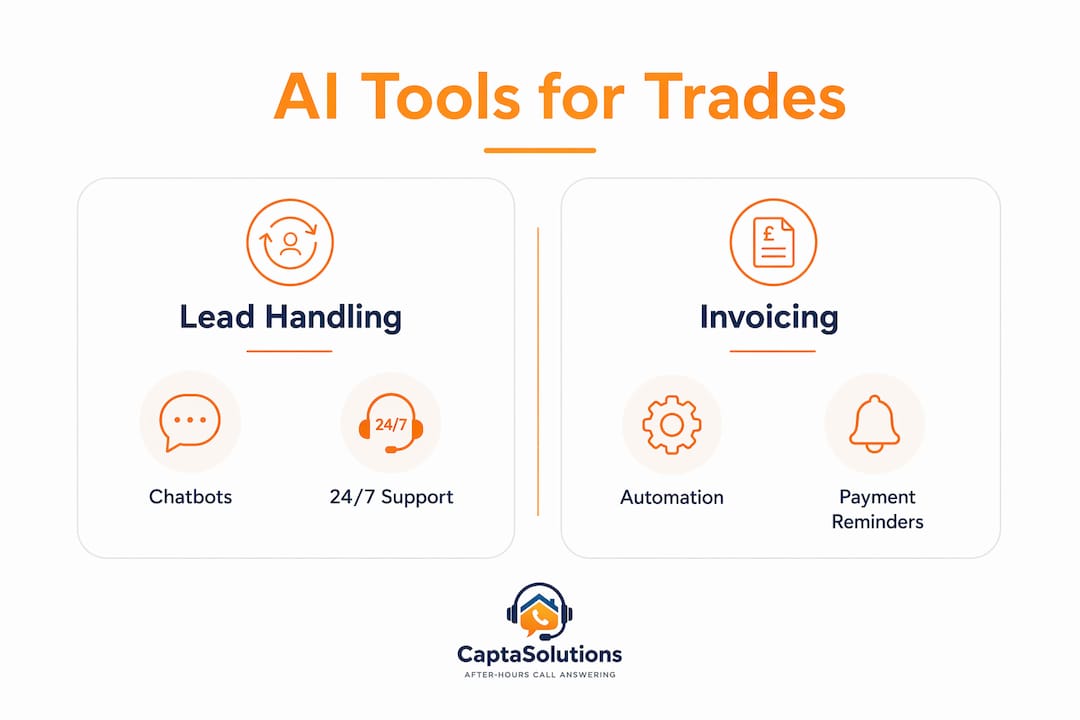
AI tools for trades businesses fall into three practical categories: lead handling, invoicing automation, and workflow integration. Each targets a different bottleneck in the typical trades operation.
AI chatbots for lead handling and booking
AI chatbots handle lead enquiries 24 hours a day, 7 days a week, qualifying callers and capturing job details without any manual input from the tradesperson. AI chatbots convert 35–50% more enquiries into booked jobs compared to unanswered calls or delayed responses. Deployment costs typically run between £800 and £2,500, with monthly fees of £40–£120. That is a modest outlay relative to a single lost job. For a plumber or electrician on site all day, this kind of AI-powered enquiry handling means no lead goes cold while they are working.

Invoicing automation with Sage Copilot
Sage Copilot, part of Sage Sole Trader Free, automates invoice drafting and payment reminders for sole traders. It removes the need to manually chase payments or draft the same invoice template repeatedly. The time saving compounds quickly across a busy month of jobs. This is a clear example of the role of AI in UK sole trader operations: removing low-value admin so the tradesperson can focus on billable work.
CRM and job management integration
AI tools that connect directly to CRM and job management systems deliver more value than standalone apps. When a chatbot qualifies a lead and immediately writes that data into a booking system, the entire workflow accelerates. Enterprise Nation research shows 71% of UK SME AI users feel more effective as business leaders after adopting AI tools, with ChatGPT, Gemini, and Copilot among the most widely used.
Pro Tip: Before buying any AI tool, map the exact point in your workflow where time is lost. A chatbot that does not connect to your booking system will create a second admin task, not remove one.
How does AI integration affect workflow and productivity in trades?
The difference between AI that saves time and AI that creates extra work comes down to how deeply it is embedded in existing processes. This distinction is what separates horizontal AI tools from vertical or custom AI solutions.
| Feature | Horizontal AI tools | Vertical or custom AI |
|---|---|---|
| Examples | ChatGPT, Gemini, Copilot | Trades-specific chatbots, Sage Copilot |
| Setup time | Hours to days | Days to weeks |
| Workflow fit | Generic, requires manual adaptation | Built around specific trades processes |
| Productivity gain | Moderate | Significantly higher |
| Data integration | Limited without configuration | Direct sync with CRM and booking systems |
Broad off-the-shelf AI tools could add £400 billion to UK GDP over ten years. Workflow-integrated vertical AI tools could push that figure to around £1 trillion. The gap between those two numbers reflects exactly what trades businesses leave on the table when they use generic tools without redesigning their processes around them.
NatWest demonstrates this principle at scale. NatWest uses AI to automate trade finance checks, speeding up complex processes and improving fraud protection. The lesson for trades businesses is the same: AI embedded into a specific workflow outperforms AI bolted on as an afterthought.
Most AI pilots in small trades businesses fail because the workflow is never redesigned. The AI is added to an existing process without defining where it starts, where it ends, and who reviews its output. The result is duplicated effort rather than reduced admin.
Pro Tip: Define three things before deploying any AI tool: the exact task it will handle, the data it needs to do that task, and the human review step that follows. Without all three, the tool will underperform.
What cultural and operational challenges affect AI adoption in UK trades?
Technical barriers are not the primary obstacle to AI adoption in UK businesses. The real challenges are cultural and organisational.
AI adoption across UK Professional and Business Services sits at 43%, with workforce involvement and human oversight identified as the main barriers rather than cost or technical complexity. For trades businesses, this translates into specific, practical challenges.
-
Workforce resistance to change. Tradespeople who have run their business a certain way for years are often sceptical of tools that change their daily routine. The solution is to involve the team in selecting and testing AI tools, not to impose them from the top down.
-
Unclear responsibility models. When AI handles a customer enquiry, someone must still own the outcome. Trades businesses that fail to assign clear human accountability for AI-generated leads or invoices end up with errors that no one catches.
-
Inconsistent data inputs. AI invoicing tools only save time if the underlying job data is accurate and current. A tradesperson who does not update job completion status promptly will find that automated reminders go out at the wrong time, damaging client relationships.
-
Lack of training and realistic expectations. Many trades business owners expect AI to work perfectly from day one. The reality is that any AI tool requires a short calibration period and ongoing adjustment. Setting realistic expectations from the outset prevents early abandonment.
-
Poor change management. Introducing AI without a clear plan for how it fits into daily operations creates confusion. A simple written process, even a one-page document, that describes what the AI does and what the tradesperson does next, reduces friction significantly.
The GOV.UK AI Champions adoption plan identifies these cultural factors as the primary reason adoption stalls. Addressing them is not a technical task. It is a management one.
How can UK trades businesses measure and maximise AI benefits?
Measurement is what separates businesses that get lasting value from AI and those that abandon it after a few weeks. The right metrics are specific, practical, and tied directly to trades operations.
- Hours saved per week. The benchmark is 5.2 hours per week for UK SMEs already using AI. Track your own figure from week one to establish a baseline and monitor progress.
- Enquiry-to-booking conversion rate. AI chatbots that qualify leads and sync with booking systems directly improve this metric. Measure it before and after deployment to quantify the impact.
- Invoice payment time. Automated reminders from tools like Sage Copilot reduce the average time between job completion and payment. Track average debtor days monthly.
- Error rate in admin tasks. Count the number of invoicing errors, double-bookings, or missed follow-ups per month. AI should reduce this figure measurably within the first 60 days.
- Response latency. The time between a customer enquiry and a qualified response is a direct driver of booking rates. AI that captures enquiries in real time and synchronises outcomes with booking systems reduces this to near zero.
The greatest short-term AI value for trades businesses is in productivity gains and error reduction, not immediate revenue growth. Setting metrics around those two outcomes gives a realistic picture of what AI is actually delivering.
Pro Tip: Review your AI metrics monthly for the first three months. If a tool is not moving at least one of your key numbers, the workflow around it needs adjusting before you consider replacing the tool itself.
Key takeaways
AI delivers the strongest efficiency gains for UK trades businesses when it is embedded directly into existing workflows rather than used as a standalone tool.
| Point | Details |
|---|---|
| Time savings are measurable | UK SMEs using AI save 5.2 hours per week, making productivity the clearest early metric. |
| Tool choice matters | Vertical AI tools built for trades outperform generic horizontal tools like ChatGPT used in isolation. |
| Cultural barriers dominate | Workforce involvement and clear responsibility models matter more than technical setup. |
| Data quality drives results | AI invoicing and chatbot tools only perform well when source data is accurate and consistently updated. |
| Measure before and after | Track conversion rates, response latency, and error rates from day one to prove and protect ROI. |
What I have learned from watching trades businesses adopt AI
The trades businesses I see getting real value from AI are not the ones with the most sophisticated tools. They are the ones that did the boring work first: mapping their workflow, identifying the exact point where time was being lost, and then choosing a tool that addressed that specific problem.
The most common mistake is buying an AI tool because it sounds impressive, then trying to fit the business around it. That approach almost always fails. The tool ends up creating a new admin task rather than removing an old one.
The cultural dimension is underestimated. A sole trader who does not trust the AI to handle customer calls will override it constantly, which defeats the purpose entirely. Building that trust takes time and requires seeing the tool work correctly on real enquiries. The first few weeks matter enormously.
My honest view is that the trades businesses that will benefit most from AI over the next three years are not the largest ones. They are the sole traders and small firms that adopt one or two well-chosen tools, integrate them properly, and measure the results consistently. The AI impact on UK trades will be felt most acutely at that level, because the efficiency gains represent a proportionally larger share of a small operation's total capacity.
The future outlook is straightforward. AI in trades will move from optional to expected. Customers already expect fast responses. Businesses that cannot deliver them will lose work to those that can.
— Daniel
How Captasolutions helps UK trades businesses answer every call
Every missed call is a missed job. For a tradesperson on site, that is the reality every working day.
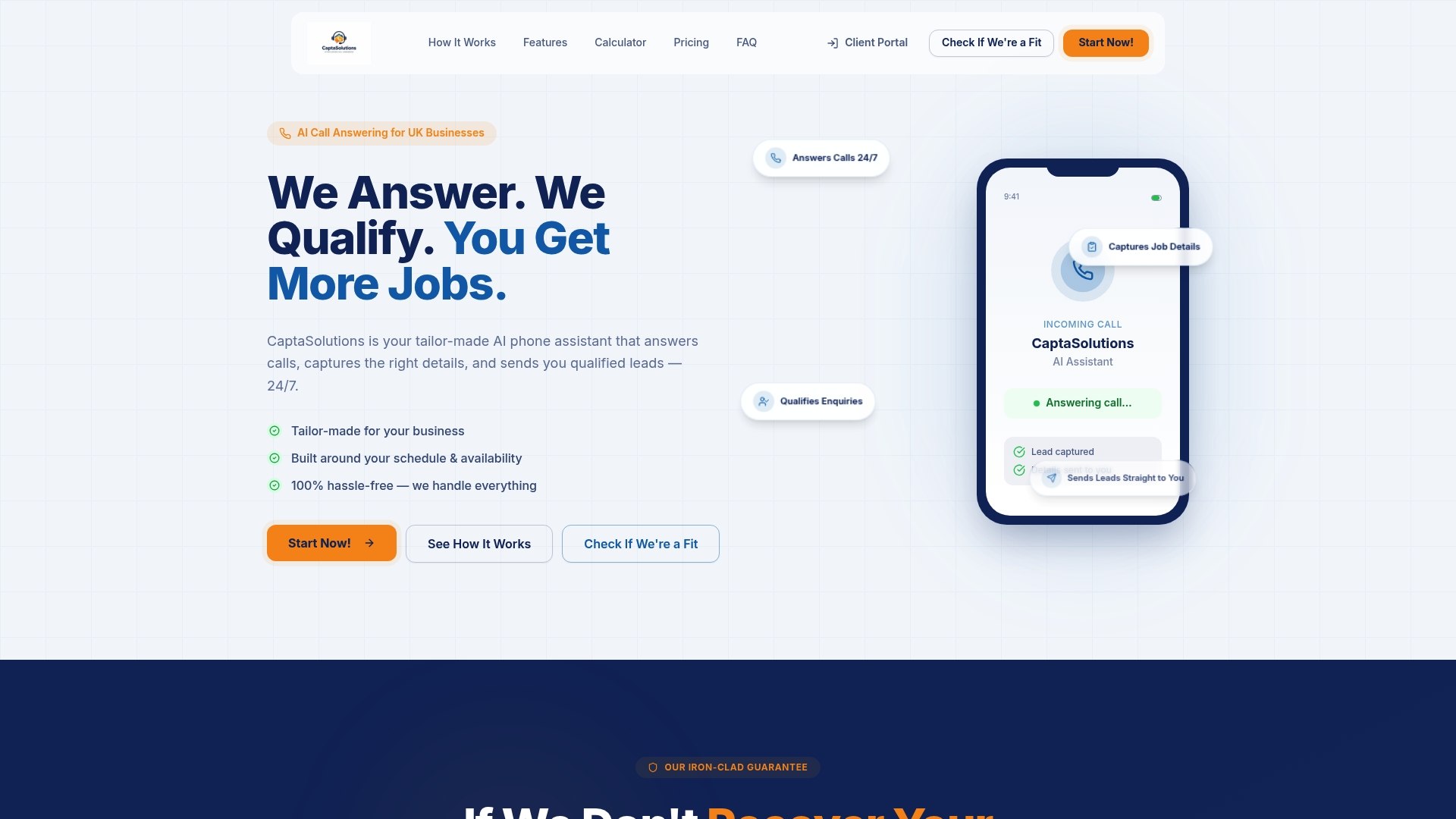
Captasolutions is an AI-powered call answering service built specifically for UK businesses that cannot afford to miss a call. The AI answers every call in your business name, 24 hours a day, 7 days a week. It captures caller details, qualifies the enquiry, and organises everything into your client portal. You review every lead and decide what to take on. There is no contract, no card required, and the service goes live within the hour. Trades businesses across the UK use Captasolutions to keep their pipeline moving without adding admin. A free 30-day trial is available at captasolutions.co.uk or by calling 07346 811329.
FAQ
How much time can AI save a UK trades business each week?
UK SMEs using AI save an average of 5.2 hours per week, with time saved, reduced errors, and lower operational costs as the top reported benefits. For a sole trader, that is the equivalent of reclaiming half a working day.
What is the difference between horizontal and vertical AI tools for trades?
Horizontal AI tools like ChatGPT are general-purpose and require manual adaptation to fit trades workflows. Vertical AI tools are built around specific trades processes, such as lead qualification or invoicing, and deliver higher productivity gains because they integrate directly with booking and CRM systems.
Why do most AI pilots fail in small trades businesses?
Most AI pilots fail because workflows are not redesigned to define where the AI operates, where it hands off to a human, and how data flows between systems. Adding AI to an unchanged process creates duplication rather than efficiency.
How does AI help with missed calls for tradespeople?
AI call answering tools capture caller details and qualify enquiries in real time, even when the tradesperson is on site. This prevents leads from going cold and improves enquiry-to-booking conversion rates directly.
Is AI invoicing automation suitable for sole traders?
Sage Copilot, part of Sage Sole Trader Free, automates invoice drafting and payment reminders for sole traders. The tool works best when job completion and payment terms data is kept accurate and updated consistently after each job.