

UK call answering services typically cost between £50 and £500+ per month, depending on billing model, call volume, and coverage hours. AI-powered services such as Captasolutions generally run on fixed monthly subscriptions, while traditional human answering bureaus bill per minute and costs rise quickly with volume and out-of-hours demand.
Here is a quick overview of what to expect:
- Per-minute billing: common with human answering bureaus; light-usage plans start around £50/month and climb steeply as call duration and after-hours coverage increase.
- Per-call pricing: a flat fee per answered call, typically used by PAYG services; straightforward for predictable, short-call businesses.
- Monthly subscription tiers: AI receptionist packages range from roughly £99/month for basic plans to £500+/month for SME tiers, with enterprise deployments reaching £2,000+/month.
- Pay-as-you-go (PAYG): no monthly commitment; you pay per call or per minute, which suits very low-volume businesses but rarely offers the best unit rate.
- Common extras that change the total: out-of-hours premiums, call transfer fees, setup charges, CRM integration costs, and overage rates when you exceed your plan allowance.
Key takeaways
Subscription-based AI answering services typically deliver more predictable monthly costs than per-minute human bureaus, particularly for businesses needing 24/7 coverage or handling moderate-to-high call volumes.
| Point | Details |
|---|---|
| Headline UK price ranges | Human bureaus start around £50/month; AI subscriptions run £99–£500+/month depending on tier and features. |
| Per-minute billing risk | Rounding rules and out-of-hours premiums can inflate per-minute invoices well above the headline rate. |
| Estimate before you commit | Use three months of call data and request a sample invoice from every provider before signing anything. |
| AI crossover point | Industry guidance cites roughly 100–200 calls per day as the band where AI typically becomes more cost-effective than human bureaus. |
| Captasolutions | Offers 24/7 AI answering on rolling monthly terms with a 30-day free trial and no card required, making it straightforward to test real costs before committing. |
Table of Contents
- How does call answering cost in the UK actually work?
- What drives your monthly call answering bill?
- Typical UK price ranges and worked scenarios
- How to estimate your monthly call answering bill
- What questions should you ask before choosing a plan?
- When does an AI answering service become more cost-effective than a human bureau?
- The pricing conversation most businesses are having too late
- Captasolutions: test your real answering costs with no commitment
- Sources
How does call answering cost in the UK actually work?
The billing model you choose shapes your invoice more than the headline rate does. Understanding each model before you request quotes prevents the most common budgeting mistakes.
Per-minute billing
Per-minute billing is the standard model for human answering bureaus. The clock starts when an agent picks up and stops when the call ends. Providers typically round up to the nearest 30 seconds or full minute, which means a 65-second call is billed as two minutes.
A business that receives a significant share of its calls outside 9–5 will feel this sharply.
Per-call pricing
Per-call pricing charges a flat fee for each answered call regardless of duration. It suits businesses whose calls are short and consistent, such as appointment confirmations or simple enquiry handling. The risk is that a provider may impose a minimum call count per month, so a quiet month still generates a minimum charge.
Monthly subscription tiers
Subscription pricing is the dominant model for AI-powered answering services. You pay a fixed monthly fee that covers a defined allowance of calls or minutes, plus the platform features included at that tier. Basic AI packages typically start around £99–£149/month; SME tiers sit in the £150–£500 band; enterprise deployments run from £500/month upward. Setup fees vary from £0 for simple configurations to several hundred pounds for custom scripting and CRM integration.
The key advantage is cost predictability. You know your base cost before the month begins.
Pay-as-you-go
PAYG removes the monthly commitment entirely. You pay per call or per minute as they occur, with no floor. For a business receiving fewer than 30–40 calls per month, PAYG can be the most affordable option. Above that volume, a subscription almost always delivers a lower unit cost.
What drives your monthly call answering bill?
Several variables determine whether your invoice lands at the low or high end of the published range. Knowing them lets you control spend and ask sharper questions when comparing providers.
Primary cost drivers:
- Call volume: the single biggest lever. More calls means more minutes billed or a higher subscription tier.
- Average call length: longer calls cost more on per-minute plans. A 3-minute average versus a 90-second average can double your bill on the same call count.
- Coverage hours: 24/7 answering costs more than business-hours-only coverage, particularly on human-agent plans where out-of-hours rates are higher.
- Call complexity: basic message-taking is cheaper than lead qualification, appointment booking, or multi-step scripting.
- Integrations: CRM integration, call recording, and transcription often carry additional monthly fees or one-off setup charges.
Common add-ons and hidden fees to watch for:
- Call transfer fees (charged per transfer, not per call)
- Script update charges when you change your call-handling instructions
- Per-site surcharges on multi-location businesses using traditional bureaus
- Overage rates when you exceed your monthly allowance, which can be significantly higher than the in-plan per-minute rate
- Minimum monthly spend clauses that apply even in quiet months
Pro Tip: The single most common budget surprise is the out-of-hours premium. Ask every provider for their exact after-hours rate and the proportion of calls they expect to fall outside business hours based on your sector. A tradesperson receiving emergency calls at 7pm pays a very different effective rate than an office receiving calls only between 9am and 5pm.
On contract terms: many UK providers offer rolling monthly agreements, which makes it straightforward to trial a service during a busy period and cancel without penalty. Starting on a rolling monthly term is almost always the lower-risk approach.
Typical UK price ranges and worked scenarios
The table below shows headline ranges across the main billing models and what is typically included at each level.
| Billing model | Typical price range | What is usually included |
|---|---|---|
| Per-minute (human bureau) | From £50/month (light usage) to £300–£500+/month | Message-taking, call transfers, business-hours coverage |
| Per-call (PAYG) | Variable; no monthly minimum | Answered calls, basic message capture |
| AI subscription (basic) | £99–£149/month | 24/7 answering, lead capture, client portal |
| AI subscription (SME) | £150–£500/month | 24/7 answering, CRM integration, call recording, custom scripting |
| AI subscription (enterprise) | £500–£2,000+/month | Full integration, multi-site routing, dedicated support |
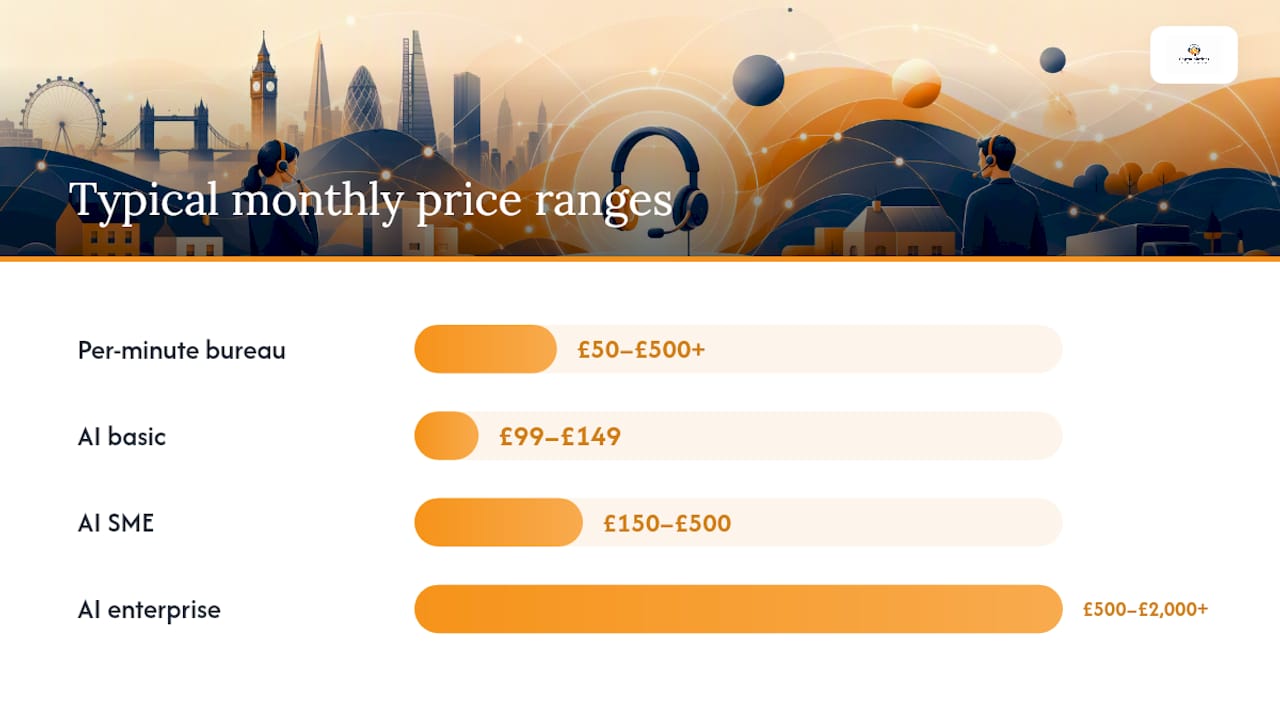
Setup fees commonly range from £0 for straightforward AI configurations to several hundred pounds for bespoke CRM integration and custom voice scripting.
Scenario 1: Low-volume SME (sole trader or small office) A business receiving around 80 calls per month, mostly during business hours, with an average call length of 90 seconds. On a per-minute human bureau plan, that is roughly 120 minutes billed per month. At a typical bureau rate, this sits comfortably within a light-usage plan. An entry-level AI subscription at £99–£149/month would cover this volume with 24/7 availability included, often at a comparable or lower total cost.
Scenario 2: Growing business with moderate volume A business handling 300 calls per month, mixed hours, average call length of 2 minutes. That is 600 billed minutes per month on a per-minute plan, which pushes well into mid-tier bureau pricing. An SME-tier AI subscription in the £150–£300/month range typically covers this volume with CRM integration and call recording included.
Scenario 3: Multi-site or 24/7 operation A business with two or three locations, receiving calls around the clock. Traditional bureaus often apply per-site surcharges, and out-of-hours premiums on human-agent plans make 24/7 coverage expensive at scale. AI platforms typically consolidate multi-site routing under a single licence, removing the per-site multiplier. An enterprise AI tier at £500–£1,000/month may cost less than a human bureau covering the same volume and hours across multiple sites.
How to estimate your monthly call answering bill
A simple formula covers most scenarios. Pull three months of call data before you run it, because a single month can be unrepresentative.
The formula:
- Count your average monthly calls.
- Multiply by your average call length in minutes.
- Multiply by the provider's per-minute rate (if on a per-minute plan).
- Add the monthly subscription or platform fee.
- Add any fixed extras: transfer fees, CRM integration, after-hours premium uplift.
Worked example (SME on a per-minute plan):
- 300 calls per month × 2 minutes average = 600 billed minutes
- 600 minutes × a per-minute rate = monthly usage charge
- Add monthly platform/subscription fee
- Add estimated transfer fees (say, 40 transfers per month at a per-transfer rate)
For an AI subscription, steps 1–3 collapse into a single tier fee. The calculation becomes: monthly subscription + overage if you exceed the plan allowance + any integration fees.
Where estimation errors most commonly occur:
- Underestimating average call length. Most businesses guess 60–90 seconds; actual averages, once message-taking and qualification are included, often run 2–3 minutes.
- Ignoring seasonal peaks. A restaurant in December or a tradesperson in January may receive 2–3 times their average monthly call volume.
- Forgetting the rounding rule on per-minute plans. Always ask whether the provider rounds to the nearest 30 seconds or full minute.
- Treating the headline rate as the all-in rate. Request a sample invoice from the provider using your own call profile before committing.
Pro Tip: Copy this formula into a spreadsheet with three columns: low estimate, mid estimate, and high estimate. Use your quietest month, your average month, and your busiest month as inputs. The spread tells you whether a subscription or a PAYG model gives you the more predictable annual cost.
What questions should you ask before choosing a plan?
Pricing knowledge is only useful if you apply it at the point of comparison. A checklist of direct questions cuts through vague sales conversations quickly.
Questions to ask every provider on cost and contract:
- What is your per-minute or per-call overage rate once I exceed my plan allowance?
- Do you charge a premium for calls outside business hours, and what is that rate?
- How do you round call duration for billing purposes?
- Is there a minimum monthly spend or minimum call commitment?
- What is the trial length, and does it require a card or upfront payment?
- What is the cancellation policy on a rolling monthly plan?
- Are call transfers, script updates, and CRM integration included or billed separately?
Trust signals worth seeking:
- Published pricing on the provider's website (not "contact us for a quote" for every tier)
- A free trial with no card required
- Rolling monthly terms rather than a mandatory annual contract
- Clear SLA or uptime commitment for 24/7 coverage
- Call recording and transcription included or available as a disclosed add-on
- Fast onboarding, ideally same-day or within the hour, so you can test with real calls quickly
When comparing quotes, always use the same call profile across every provider. Give each one your actual monthly call count, average duration, and the proportion of calls outside business hours. Ask for a sample invoice rather than a rate card. Rate cards rarely reflect what you will actually pay.
Red flags to watch for:
- Overage rates that are not disclosed until you ask directly
- Per-site charges that multiply your cost as you add locations
- Frequent script-change fees that make it expensive to update your call-handling instructions
- Contracts that auto-renew annually without a clear opt-out window
- Providers who cannot tell you their after-hours rate before you sign up
On compliance: if call recording or transcription is part of your plan, ask the provider how they handle consent and data governance. This matters for call recording and automated transcription under UK data protection rules.
When does an AI answering service become more cost-effective than a human bureau?
The short answer is: sooner than most businesses expect, particularly once out-of-hours coverage and call volume both increase.
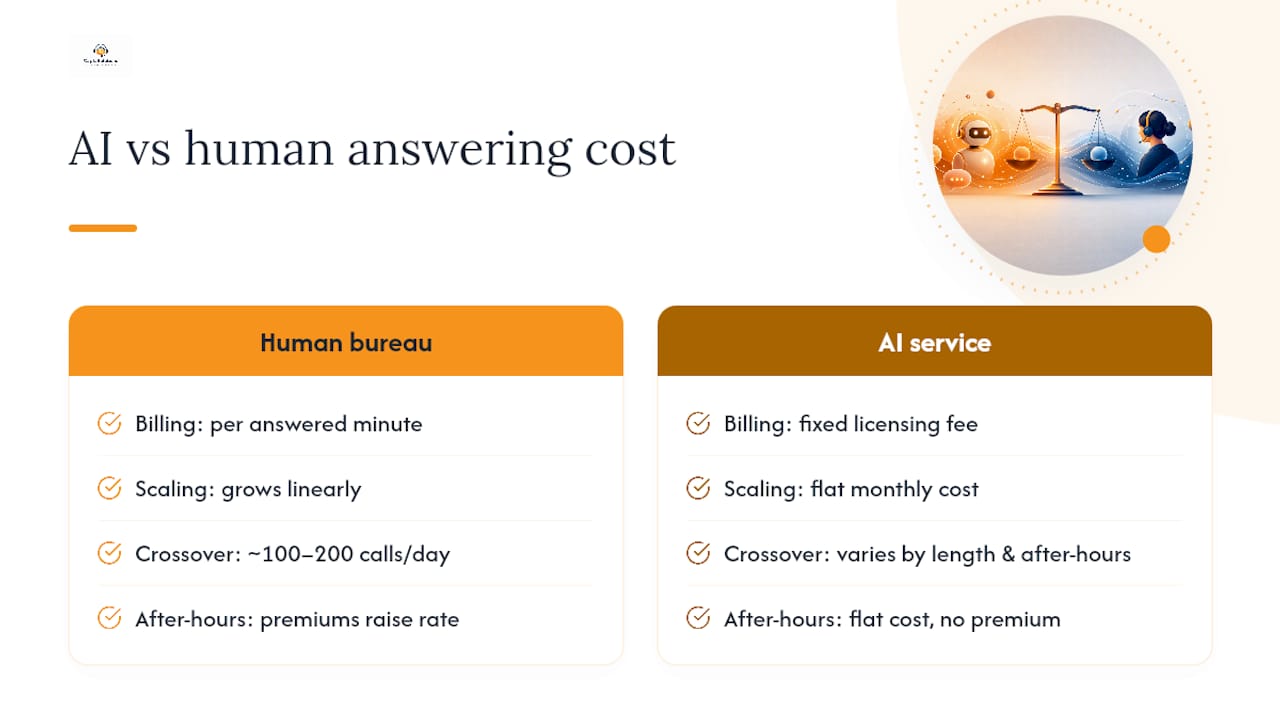
Human answering bureaus bill every answered minute. As volume grows, so does the invoice. Out-of-hours premiums compound the effect: a business receiving a meaningful share of calls in the evening or at weekends pays a materially higher effective rate than its daytime rate suggests. Industry guidance places the inflection band where AI typically becomes more cost-effective at around 100–200 calls per day for mid-market businesses, though the precise point depends on call length and after-hours proportion. For smaller businesses, the crossover can occur at much lower volumes once 24/7 coverage is factored in.
The mechanics are straightforward. AI answering services operate on fixed licensing. A business paying £200/month for an AI subscription handles 100 calls or 1,000 calls at the same cost. A human bureau billing per minute scales linearly with every call. At moderate volumes, the two models may be comparable. At higher volumes, or whenever out-of-hours coverage is required, the AI model typically wins on cost.
For UK small businesses considering AI call answering, the cost argument is strongest when the business needs consistent coverage outside standard hours and cannot justify a full-time receptionist.
Pro Tip: When switching from a human bureau to an AI service, expect a 2–4 week calibration period. The AI needs real call data to refine its handling of your most common enquiry types. Run the two services in parallel for the first two weeks if your call volume is critical to revenue, so no leads fall through during the transition. Most AI providers, including Captasolutions, can go live within the hour — the calibration period is about optimisation, not setup.
The pricing conversation most businesses are having too late
The conventional advice on call answering costs focuses almost entirely on headline rates. Compare per-minute prices, pick the cheapest plan, done. That approach consistently produces budget overruns, because the headline rate is rarely the number that matters.
The figure that actually determines your monthly invoice is the effective rate: what you pay per call once overage, after-hours premiums, transfer fees, and rounding rules are applied. Businesses that discover this after signing a contract have limited options.
The more useful question to ask before selecting a plan is not "what is your per-minute rate?" but "what will my invoice look like in a busy month?" That requires a sample invoice based on your actual call profile, not a rate card. Most providers will produce one if you ask. Those who will not are telling you something.
There is also a broader point that the cost-comparison framing tends to obscure. The value of a call answering service is not just cost avoidance; it is revenue capture. A missed call from a new customer is not a neutral event. That customer calls the next business on their list. The ROI calculation for a well-configured answering service, particularly one that qualifies leads and routes them to a client portal, often makes the monthly subscription look modest against the leads it captures. Businesses that treat answering services purely as a cost centre tend to under-invest and then wonder why the service does not pay back.
Captasolutions: test your real answering costs with no commitment
Every missed call is a missed lead. Captasolutions answers every inbound call in your business name, 24 hours a day, 7 days a week, capturing caller details, qualifying the enquiry, and organising everything into your client portal. No per-minute billing. No after-hours premium. No per-site surcharge.
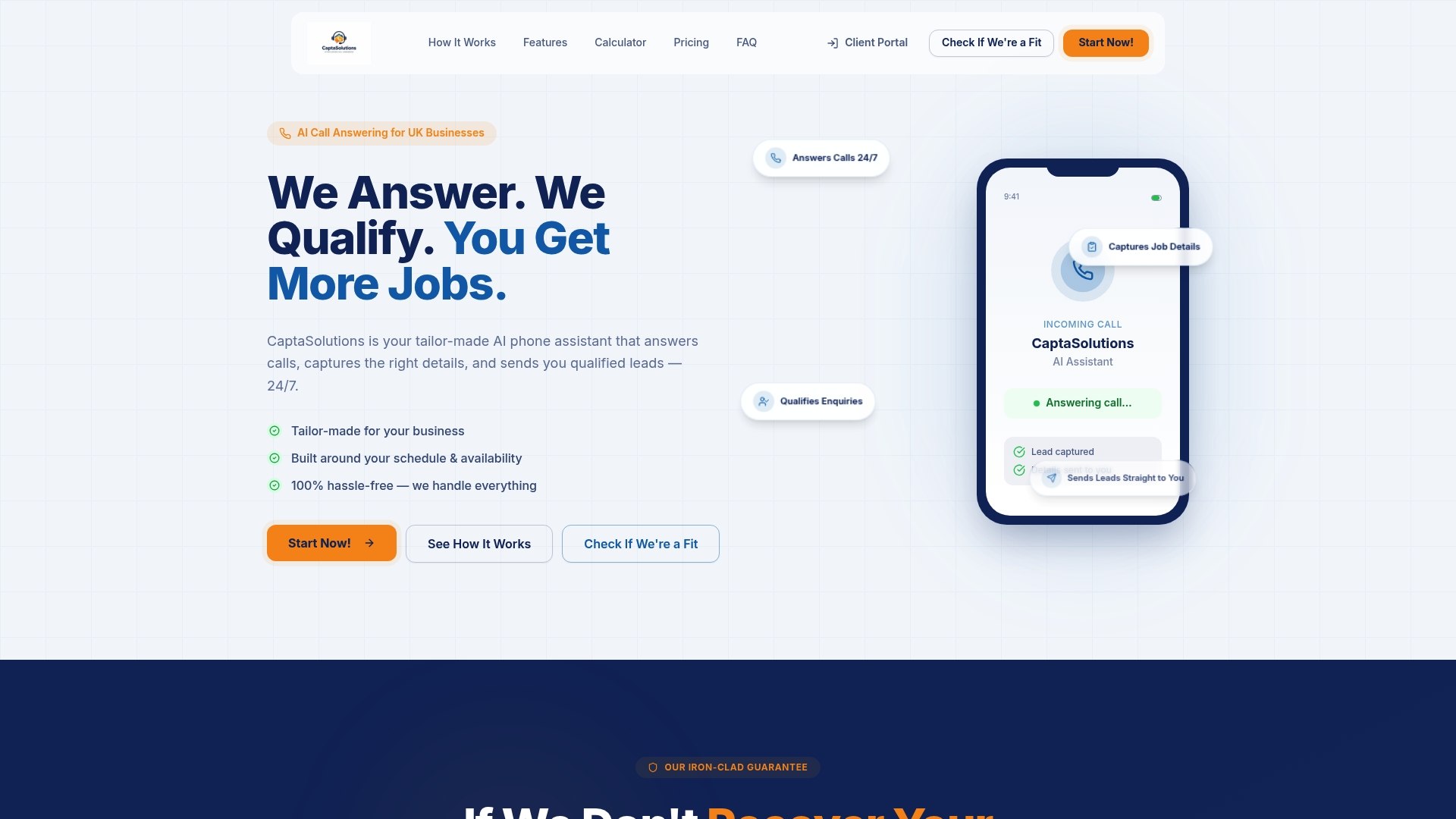
The 30-day free trial requires no card and no contract. You go live within the hour, which means you can run a real trial using your actual call volume and see exactly what your monthly cost looks like before you commit to anything. Rolling monthly terms mean you are never locked in. Setup fees are disclosed upfront. There are no overage surprises on standard plans.
For trades businesses, restaurants, salons, clinics, and service businesses across the United Kingdom, Captasolutions removes the guesswork from call answering costs. Start your free trial at Captasolutions or call 07346 811329.
Sources
The sources below are worth consulting when benchmarking prices and requesting quotes from providers.
- Telephone Answering Service: What It Does and Costs | CallFactory | CallFactory